Thursday, January 4, 2024

Favorite Reads, 2023

 You can see that we are already well into 2024, but I wanted to share my favorite reads of 2023. Some are independently published books and we all know those can use all the word-of-mouth possible! My reading numbers have gone down in recent years, as I do so much reading for editing, teaching, and now, publishing! I'm not complaining! I love each of these aspects of my book life. In 2023, I read a total of 32 books for "leisure" - whatever that is. I read twenty-one novels, two novellas, one story collection, four graphic novels, two memoirs, and two collections of essays.

Here are my top five reads of the year...and three honorable mention choices. Each of these books, in my opinion, is well worthy of your time. If they could capture my attention and heart in this tumultuous and busy year, that should be worth something! And in no particular order, they are:


Here's the publisher's description: 

"This gripping novel—inspired by true events—tells the interwoven stories of a deformed German infantryman; a lonely British film director; a young, blind museum curator; two Jewish American newlyweds separated by war; and a caretaker at a retirement home for actors in Santa Monica. They move through the same world but fail to perceive their connections until, through seemingly random acts of selflessness, a veil is lifted to reveal the vital parts they have played in one another's lives, and the illusion of their separateness."

I love everything I've ever read by Simon Van Booy, and this was no exception. His style reminds me of some of my very favorite authors - Kent Haruf, Per Petterson - and the way he cuts through to the heart of his characters. 


A classic, for good reason, and probably the book I recommended most this year. A six-year-old girl and her grandmother spend a summer on an island in the gulf of Finland. This slim moment is full of small, tangible moments and big truths, of longing and love, of the complicated tangle of relationships and life itself. If you only listen to me about one book on this list, make it this one (and check out the author's other writing as well).


A reviewer said “Beautifully written and satisfyingly creepy, this is one of the most poignant and original ghost stories I've ever read.”

I agree! This book will surprise you, enthrall you, and keep you thinking long after you set it down. It's about family and time and memory, and the relationships that define us. 

I'm thrilled that I'll have a chance to hear the author talk about the story in person this year.


Full disclosure: this author has a young adult fantasy book coming out with Type Eighteen Books this April, and she kindly sent me this copy of her earlier book. Elizabeth has done and continues to do many amazing things, but at some point, she was a shepherd, and the local "Ask a Shepherd" on a CBC radio show. This is a collection of her letters for the show, and I found it compulsively readable, endlessly fascinating, and representative of her particular charming and intelligent writing - which is why we took on her new book in the first place. I loved this unique read.


This book was the last in my Summer of Summer reading project...and now I'm realizing I never wrote a post about it. I loved it! An eerie and immersive read about a relationship that begins over the course of a summer and goes through a series of changes and transformations, as relationships do. I loved the POV of this novel, an unreliable character who is simultaneously exasperating and completely relatable. Once in, I had a hard time putting this book down.


And now the honorable mentions:

Another slow cooker book. This one takes place in the late 1960s, in the English countryside where an awkward single woman eavesdrops on the interesting couple residing below her. The publisher calls it "a seductive psychological portrait, a keyhole into the dangers of longing and how far a woman might go to escape her past."


Like a couple of my other choices this year, this book surprised me with its approach and twists. Recommend!


A story collection from the same publisher as Magdalena - they're doing something right! The writing in this collection is gorgeous, and the settings and range of characters are fresh and surprising (I guess I wanted to be surprised this year?!?). And like most writing I like, the characters are relatable and leave me with emotional or intellectual takeaways. I must read more short stories in 2024!


I loved this story written by a daughter about her mother's life. From the publisher: 

"The story of a woman whose life spanned a century of tumult and change. In many ways Nance’s story echoes that of many mothers and grandmothers, for whom the spectacular shifts of the twentieth century offered a path to new freedoms and choices. In other ways Nance was exceptional. In an era when women were expected to have no ambitions beyond the domestic, she ran successful businesses as a registered pharmacist, laid the bricks for the family home, and discovered her husband’s secret life as a revolutionary."


This is a brief, perhaps not formatted expertly post, but I did want to share my favorite books of 2023. And I do pay attention to your Best Of posts, too, and usually add many of your choices to my list. Happy reading in the new year, everyone!

Sunday, August 20, 2023

The Summer of Summer: Flights


This might sound trite, or too on-the-nose, but reading Flights, Olga Tokarczuk’s unique book about many things under the umbrella of “travel” is like taking a journey. The best kind of travel journey, where you meander down one road to discover something that wasn’t in any of the guidebooks or maps. I’m not even sure how to describe this read, this wholly original book.

At times, it reminded me of another book with a big impact on me: Outline by Rachel Cusk. In that book, our narrator never introduces herself in a traditional way, and we learn about her as she moves through the world and interacts with others—thus, an outline of the person she is emerges. In Flights, Tokarczuk introduces herself from the start. She relays some of her earliest memories and talks about her parents’ methods of travel and therefore, her childhood exposure to the concept. After her parents spent time at a campsite or abroad, like most of us, they’d return home to jobs and bills and a worn path in the carpet of their flat. But the author claims her divergent path:

“That life is not for me. Clearly I did not inherit whatever gene it is that makes it so that when you linger in a place you start to put down roots. I’ve tried, a number of times, but my roots have always been shallow; the littlest breeze could always blow me right over…My energy derives from movement—from the shuddering of buses, the rumble of planes, trains’ and ferries’ rocking.”

And then, unlike Cusk’s traditionally undefined narrator, Tokarczuk gives a full run-down of herself:

“I have a practical build. I’m petite, compact. My stomach is tight, small, undemanding. My lungs and my shoulders are strong. I’m not on any prescriptions–not even the pill—and I don’t wear glasses.”

Etc., until the focus narrows.

“My abdominal aorta is normal. My bladder works. Hermoglobin 12.7. Leukocytes 4.5. Hematocrit 41.6. Platelets 228.” 

And more!

Why? Again, it’s hard to describe this book, which meanders down so many paths having to do with travel and permanence, moving and staying, life and death. There are stories heard during travel, stories about people met and places visited. There are conversations relayed from life on the road: on plane trips, in foreign cafes and bars, discussions had while waiting to go someplace else. And the book returns many times to meditations about the human body and everything it means to have one, as our physical forms fortify us, change, and die, as we move through time and space trying to find meaning in our relation to what lies beyond us.

Have you ever gotten into to your car to drive a familiar route and sort of blank out at some point, not remembering the specifics of how you progressed to your current location? Reading Flights reminded me of that. At some point, I would pause and think “Huh. Now I’m reading about a slave whose body was preserved against his family’s wishes,” or “Now I’m following the travels of Peter I, tsar of the Russian Empire.” What all the meandering paths have in common is always some consideration of travel, or the body, or both. Flights is unlike anything I’ve read, with this tight focus on the topic while at the same time, feeling that it’s going in every direction at once. You might be thinking that it sounds like a frustrating or challenging read, and I will say that maybe early on, I felt that way, as I wet my feet. But once you’re in, you’re in, and the stories and segments wash over you easily, as if you’ve been the passenger all along. The structure of the book itself, with its short sections and asides, its starts and stops and recurring segments and themes, makes it the perfect book to take on a journey, short or long. I believe the more I think about this book, the more it will resonate. And it definitely made me want to plan a trip.

Wednesday, July 26, 2023

The Summer of Summer: The Natural


I didn’t know much about The Natural, except that it was a movie I hadn’t seen starring Robert Redford, and that some consider the book, written by Bernard Malamud and published in 1952, the quintessential, literary baseball novel. And baseball is a summer game (in theory, although it runs from April into October, if you’re lucky); choosing this book for my Summer of Summer seemed like an easy choice. I even got my son to read along with me on vacation.

I was expecting a hero’s journey type of book, the story of a scrappy slugger and his rise in the leagues (again, with the image of Redford in mind). Certainly, those elements are there. The book opens with Roy Hobbs, a nineteen-year-old pitcher on his way to try out for the Chicago Cubs. We know his talents are considerable when the train stops at a carnival and he strikes out “the Whammer,” a top hitter in the game.

But this hero’s journey has its trials, as they do, and Roy is a tragic character more than anything else. Without giving away any of the plot’s surprising twists, I will tell you that often, Roy’s challenges come wrapped in a female package. Sidenote: the women in this story have great names: Harriet Bird, Memo Paris, Iris Lemon. In fact, everyone has great names, from the beleaguered manager of the New York Knights, Pop Fisher, to the journalist trailing Roy for a scoop, Max Mercy, to the star player and Roy’s nemesis, Bump Baily.

You can get a feel for the tone of this book, written in the fifties, by these names. In this world, the men call each other “bub” and “kiddo” and “son,” and the women say things like “How droll!”

But did I like it? I appreciated the atmosphere, dialect, and winding plot, and once I got a feel for the tragic element, I appreciated the character of Roy on a symbolic level. He’s a striver, a uniquely American character in his quest for fame and greatness—spurned on by an unhappy childhood and a string of bad luck. He’s a man of appetites that cause, in many ways, his demise. And in the way of tragedies, often we readers see what’s coming down the track before the character can; many times, I wished Roy would wise up, act better, do right.

I also liked some of the exaggerated elements of the book—such as when Roy literally hits a ball so hard that the cowhide falls off—these bits felt almost apocryphal and compounded that feel of heroism and the way we raise our sports competitors to mythic levels.

When I finished the book, I started to imagine how they took this story and filmed it, and now that I’ve watched the trailer, it would seem they made it into what I imagined the story to be before I picked it up—a story of a slugger making his way to the top. We’ll see. I’m planning to watch the full movie soon.

Next up for my Summer of Summer is quite a shift, the 2007 “fragmentary novel” by the Polish author Olga Tokarczuk, Flights. Let me know what you’re reading, or if you try any on my summer list! 

Sunday, July 23, 2023

The Summer of Summer: Seating Arrangements


My second read for the Summer of Summer reading project is Seating Arrangements by Maggie Shipstead. In this story, the Van Meters have gathered for the marriage of their eldest daughter, Daphne, who is well bred and educated and nevertheless, seven months pregnant for her nuptials. This irks the father especially. Winn Van Meter was raised with certain ideas about class, gender, and appearances. He’s never moved beyond the identity he earned when he joined an exclusive Harvard club, and ramifications and associations from those days continue in his life, thirty-plus years later. As they do. The family has gathered at Waskeke, an island where rich families have summered for generations, and Winn’s ongoing, current obsession is his pending application to the elite golf club there.

It may seem from my initial notes that the novel is about Winn, and it certainly focuses on his thoughts more than others, but the story moves from character to character, giving glimpses into the perspectives of several. I have to admit, for many pages, I didn’t like anyone much. These are people who remember what they spent on oysters for their first wedding, and when young children are caught playing dress up with their mother’s jewelry, they say “This is nothing. The good stuff’s in the safe.” And then I caught myself wondering why I was feeling a bias against these characters for their lifestyle—fiction is about relating to people unlike ourselves, isn’t it? And I was thinking, too, about what I felt were the horrific “jokes” about the wealthy explorers who perished trying to see the Titanic wreck. Why is antipathy—or, at least, a lack of empathy—against the rich acceptable? Shouldn’t be. Their concerns and issues are still human.

Still. Another aspect of the novel is the sexuality that simmers from the first pages. Winn, you see, is harboring a painful attraction for one of his daughter’s friends, and he has since she was young. Overall, I found Winn tiresome, with his continual fussing to keep things in place at the house, his obsession with the golf club and why they won’t let him in, and his awkward lusting after the young woman. There are additional affairs, relationships, and thwarted romances to deal with amongst the wedding guests. The other Van Meter daughter, Livia, has recently been dumped by the son of Winn’s nemesis—the man he thinks is keeping him out of the club. As the wedding party frolics and drinks, and drinks some more, there are sexual misadventures but also mishaps with the lobster intended for the rehearsal dinner and with a wayward golf cart. Also, a dead whale has beached nearby. I did enjoy some of the ironies of the book and how they played out. Such as the fact that Winn was a “ladies’ man” in his day and now has to deal with two daughters and their forays into the sexual world, and the outing Livia (an aspiring marine biologist) makes to view the whale.

And I will tell you that at some point, it started to come together for me, this darkly funny, orchestral novel. I don’t want to spoil anything else in the plot, but I will say that the book left me contemplating privilege and class, money and expectations, gender conditioning, and sexuality as it relates to power dynamics, and the way Shipstead brought all of the simmering tensions to a satisfactory, touching, and entirely realistic finale was truly inspiring. Do I recommend this book? To a certain, patient reader, yes. To those who like to relate to a character(s) from the start, maybe not. But it definitely has something to say about wealth (and many other things) and in its own way, Seating Arrangements is a richly American story, I think. And a good summer read.


Wednesday, June 21, 2023

The Summer of Summer: The Summer Book


The back cover copy on this 1975 novel claims that it "distills the essence of the summer - it's sunlight and storms - into twenty-two crystalline vignettes." And that it does. The Summer Book by Tove Jansson centers on two characters - six-year-old Sophia, who has recently lost her mother and is navigating the loss and change that entails, and her grandmother, a headstrong expert of living on the rugged and mutable island where they spend their summers.

It's a book you'll want to read slowly - for me, a rare, five-star read. There are so many wisdoms, so many glimpses of human nature to contemplate, so many twists and dialogue that rings with the deepest truth. If there's a third, noticeable character in the book, it's probably Nature. The island consists of rocky coastline and the forested interior, and the weather can cause drought or near-swamp conditions. Sophia and her grandmother are in constant contact with their environment - exploring, playing, noticing, building. Both are angry about certain things. The grandmother, near the end of her life, resents the loss of some of her autonomy. Sophia is angry about things she's unable to voice in her young age. Of this novel, a friend of mine said that the grandmother is the best untrained psychologist she's seen. And certainly, there's a nurturing wisdom in the way she handles Sophia's meltdowns, questions, and sometimes, personal attacks.

Written in deceptively simple prose, this novel encompasses depths and depths. Each story lingers, as layers of meaning continue to rise to the surface long after reading. I could choose from many excerpts in this wonderful novel, but here's one.

The sun came up. The fog glowed for an instant and then simply vanished. Out on a flat rock in the water lay a scolder. It was wet and dead and looked like a wrung-out plastic bag. Sophia declared that it was an old crow, but Grandmother didn't believe her.

"But it's spring!" Sophia said. "They don't die now; they're brand new and just married - that's what you said!"

"Well," Grandmother said, "it did die now, all the same."

"How did it die?" Sophia yelled. She was very angry.

"Of unrequited love," her grandmother explained. "He sang and scolded all night for his scolder hen and then along came another and stole her away, so he put his head under the water and floated away."

"That's not true," Sophia screamed. She started to cry. "Long-tails can't drown. Tell it right!"

So Grandmother told her he had simply hit his head on a rock. He was singing and scolding so hard that he didn't look where he was going, and so it just happened, right when he was happier than he'd ever been before.

"That's better," Sophia said. "Shall we bury him?"

"It's not necessary," Grandmother said. "The tide will come in and he'll bury himself. Seabirds are supposed to be buried at sea, like sailors." 

I highly recommend this wonderful book for your summer pile. Next up in my summer reading project, Maggie Shipstead's Seating Arrangements.

Saturday, June 10, 2023

Summer Reading Project 2023

It's that time again! Every summer for many years, I have chosen a stack of books to tackle over the warmer and in theory, less busy, months. I choose books around a theme. I have spent summers reading books about trees, books related to France, books featuring notable houses, and last year, I read several Faulkner novels. That was one of my favorite projects so far, because Faulkner certainly is a project AND a mood, and it was an experience to be immersed in his world for that extended period. 

This year, I'm not feeling as ambitious. Lately, I read a lot for my jobs and sometimes have trouble finishing books in a timely manner. I wanted to choose novels with a decidedly summer vibe, books I might pick up while traveling. Books that really piqued my immediate interest. So I thought, why can't my theme be summer itself? I perused some lists and a couple novels came immediately to mind, and here you are, my choices for this summer's reading project, the Summer of Summer, which I'll read in this order and hopefully, share my thoughts with you. Click on each for a description:

The Summer Book by Tove Jansson

Seating Arrangements by Maggie Shipstead

The Natural by Bernard Malamud

Flights by Olga Tokarczuk

Thirst for Salt by Madelaine Lucas


If any of these pique YOUR interest, join me. And I'll be sure to update you on my progress and my impressions of these stories. Happy summer!

Saturday, December 31, 2022

Favorite Reads, 2022

The fact that I'm squeezing this post in on the last day of the year is quite representative of the year I've had! 2022 was busy, but I managed to read 30 books from my last end-of-year post to today. This range seems to be the new norm. As I sit here with my ever-expanding list of goals for 2023 (including publishing a new book - more on that soon), it may seem unrealistic to say that one of those goals is to increase this number in the new year. But that's the plan. I'd also like to make sure to include short story collections next time, so any recommendations are welcome. 

In 2022, of the 30 books I finished, 21 were novels. I also read five books of poetry, and four non-fiction titles. This year's Favorite Reads list is dominated by the author I read all summer, William Faulkner. I read five novels by the master and one biography about him, and I've included four of those six books on the list. They're that good. If, like me, you've considered returning to his work for some time...I'd highly recommend you do. So I'll start this year's list with those books.

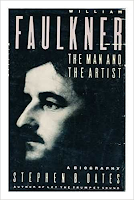
Faulkner: The Man and the Artist by Stephen B. Oates (1987)

This extremely readable biography is novelistic in approach and gives insight into the personal experiences and struggles that formed Faulkner into the man and writer he was. There was much in here I remembered about Faulkner - his troubled marriage, his drinking - and much that was new to me, such as his early support of civil rights and his long, complicated involvement in Hollywood. A great start to a study of the author and his work.

I'm including three novels as favorite reads this year. Each showcases that unique Faulknerian approach: rotating points of view and a sort of stream-of-consciousness omniscience. And yet. The aspect that surprised me the most during my summer reading project was how different each novel was, even while being unmistakably Faulknerian. Each is a masterpiece, in my opinion. They are:

The Sound and the Fury (1929)

As I Lay Dying (1930)

Light in August (1932)

I've linked each one to my original commentary. And now, the rest of my favorite reads for 2022.


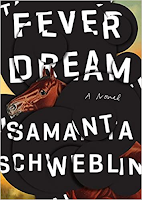
Fever Dream by Samanta Schweblin (2017)

Speaking of points of view, this slim novel will keep you guessing about who to believe and about the nature of reality itself. This haunting story about a summer vacation gone terribly wrong poses many questions about parenting, humanity's plundering of the earth, and the limits of our minds. It's compulsively readable and at times, downright scary. I've never read anything like it, and the 2021 movie adaptation (on Netflix) stays true to the tone and effect of the novel as well.


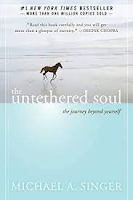
The Untethered Soul by Michael A. Singer (2007)

If you've done any work on yourself, maybe you've come to certain realizations about the weights and burdens you're carrying. Great! But how do you begin to unravel and release them? This bestselling guide to personal growth will be familiar to many. This was my first reading, but it's a book I'm certain I'll read again. The focus is on practical change, how to "free yourself from the habitual thoughts, emotions, and energy patterns that limit your consciousness." If this sounds appealing to you, give it a read. The ideas are succinctly and clearly explained, and yet will lead you to further thought and exploration. 


Flower, Grand, First by Gustavo Hernandez (2021)

Named for prominent streets in Santa Ana where the poet lives, the poems in this debut collection are contemplations about immigration, family, loss, and sexuality. Born in Jalisco, Mexico, Gus immigrated to the United States in the 1980s with his family, and his search for that birthplace and the family left behind were main inspirations. A evocative and heart-searing collection, brilliantly written. I was lucky to have the author join me for a chat about creativity and his writing, which you can view here. 


That's the list! These are my only 5-star reads for the year. But...to round out the number to an even 10, I give you three honorable mentions.


If on a winter's night a traveler by Italo Calvino (1979)

The experimental novel is, like Fever Dream, unlike anything you've read before. It's a postmodernist classic, a frame story about a reader trying to read a book called, well, If on a winter's night a traveler. It's about reading, and writing, and perspective, and how to experience storytelling, and relationships, and much more. The only reason I wouldn't give it a full five stars is because I felt that at some point, the ambitious structure and method took it slightly off the rails. 


The Best American Poetry 2021 by David Lehman (series editor) and Tracey K. Smith (guest editor)

Want to read more poetry? These anthologies are a great way to wade in. Of course, any anthology will include a wide range of writing and not all of it will be your cup of tea. That's why it's difficult to give the top rating to an anthology. But this one is very good, and now you can find the 2022 version as well.

Love by Hanne Ørstavik (2018)

Often there's a certain, raw directness about Scandinavian literature that I truly love. Authors like Fredrik Backman and Karl Ove Knausgaard have found their way into wide circulation, and personally, I anxiously await any translation of the work by one of my favorites, Per Petterson. As I write this, I'm wondering if this region should be a focus for my summer reading project...hm. 

This novel, Love, returns us to the beginning of this list, and the discussion of point of view. This slim tale tells about a day in the life of a single mother and her son. The narrative switches back and forth between their perspectives, in ways that will surprise and intrigue. The overall effect is a binding one, keeping this story taut around its mood and theme.

As always, I pay special attention to end-of-year reading lists, and would love to hear about your favorites of 2022, as well. Happy New Year to all.

Thursday, August 18, 2022

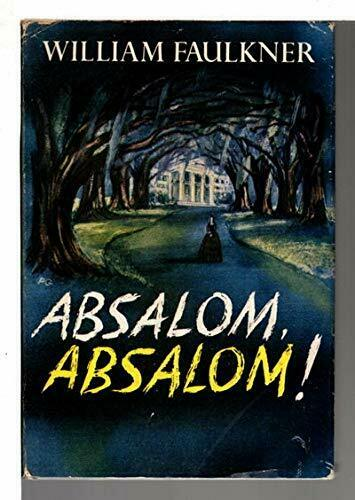
Summer of Faulkner: Absalom, Absalom!


My final read for my Summer of Faulkner is one a panel of judges in 2009 called the best Southern novel of all time (one scholar called it “the only serious rival to Melville’s Moby-Dick as the great American novel”—and well, I hated that book so I call into question this entire panel.) But I do get that Absalom, Absalom! explores the complex structure of the South—class, race, tradition—in an notably comprehensive way.

The novel tells the story of the rise and (because it’s Faulkner) inevitable fall of Thomas Sutpen, a white man who starts out poor with ambitions of power and wealth. He lives a complicated life, with past indiscretions casting shadows on his present circumstances. And his prior sins come back to haunt not only him, but his children. The whole thing is like a Shakespearean tragedy, if I’m being honest, with twists and violence and no way to a happy ending for, really, anyone.

Like the other novels I read this summer, Absalom, Absalom! (titled after the Biblical story of King David and his wayward son) addresses the decline of plantation culture, the evils of slavery, and sexual misconduct. And the novel is often lauded for its method of—you guessed it, multiple narrators. But for me, this time the method was a problem. Every narrator is both reliable and unreliable to some degree—the point being that this is how history is relayed. Sutpen’s “story” is recounted in flashbacks narrated by Quentin Compson, who got his information from a variety of sources/other narrators. There are layers upon layers as to what is “true.” And for me, the storytelling method was too cumbersome, too convoluted, and in the end, weighed down the overall effect.

Who knows—maybe I have Faulkner fatigue. I’ll allow that I didn’t read this last novel on a vacation but rather, during my regular, busy life. At times, it was a struggle to read (and don’t get me started on the almost-forty consecutive pages of italics in the middle of the book). Of course, it’s still Faulkner and there were many moments of brilliance and enough to keep me plodding along. Perhaps I’ll file Absalom, Absalom! in the “Give Another Chance” column, for sometime down the road.

And that’s a wrap on my Summer of Faulkner. Usually, I have some idea of what I’d like to do for the next summer, but I haven't really considered. I may do another author—I liked immersing myself in a single writer’s voice. Or maybe some other theme will hit me. In the meantime, I don't think I'm finished with Faulkner. I intend to read a few more over the non-summer months. He really is an incomparable writer.

Thursday, July 28, 2022

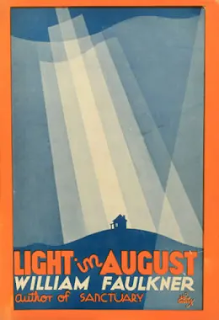
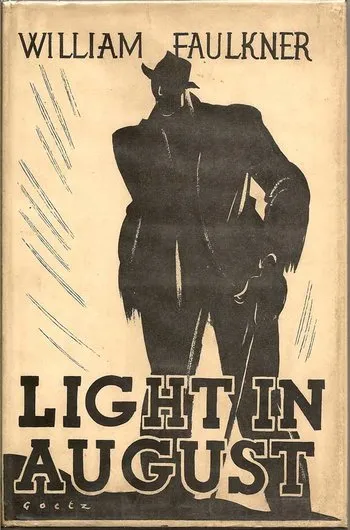
Summer of Faulkner: Light in August


Light in August begins like this:

“Sitting beside the road, watching the wagon mount the hill toward her, Lena thinks, ‘I have come from Alabama : a fur piece. All the way from Alabama a-walking.’"

and it ends like this:

“’My, my. A body does get around. Here we aint been coming from Alabama but two months, and now it’s already Tennessee.’”

The novel covers this short period during which Lena Grove finds herself in Jefferson, Mississippi, where she’s come to seek the father of her unborn child, Lucas Burch, a man who promised to send for her and didn’t.

Lena is a sympathetic character from the start, because of her situation and gumption, and because of her naivete in believing that somewhere, Burch will be waiting with the house and marriage she thinks he promised.

But Lena Grove isn’t the main character of Faulkner’s seventh novel published in 1932; one of the masterful things about the author’s method in Light in August is the alternating points of view. It’s a common, Faulknerian technique and yet, he seems to go about it in a unique way for each novel. Here, an alternating omniscience allows us into the minds of several of the characters, but often a new, periphery character is introduced at a particular moment as if to lend a degree of objectivity. In this way, the points of view contribute to the furthering of plot, while also lending depth to the themes of the book. I don't even know if I'm describing this well. A simple way to say it is that everything in this book is doing several things at once. Everything. It's truly masterful, a novel I could read over and over, I believe, and find new satisfactions each time.

We follow young, pregnant Lena into Jefferson much like a camera follows a subject. We meet other characters, each, like her, carrying some burden from the past. Reverend Hightower spent a childhood obsessed with his grandfather, a Civil War hero, and was ousted from his church position after a personal tragedy. Byron Bunch maintains a friendship with the reverend but is otherwise solitary and isolated until Lena’s arrival. Joanna Burden is a spinster whose family has a long history of anti-slavery activism and intermixing with blacks. And because one of Faulkner’s primary preoccupations in the novel is the relationship between and status for both whites and blacks in the South—well, it makes perfect sense that Joanna, with her confusion about her place among the races, becomes involved with our main character, Joe Christmas, a light-skinned man who has lived as both white and black at certain times of his life.

The characterization of Joe Christmas is nuanced and deep; he’s an orphan who suffers abuse and alienation throughout his childhood and becomes a drifter. I think one of the most impressive things about Faulkner’s drawing of this character is that even when Christmas becomes more and more corrupted and driven to terrible acts, we still feel sympathetic. Because of his violent upbringing and the lack of a mother, Christmas’s feelings for and about women are convoluted, his feelings about race, the same. He has never been allowed any sort of peace and when he finds it in short spells, he sabotages and destroys. On the race issue, never fitting in completely, he lives his life ready to fight.

“Now and then he could see them: heads in silhouette, a white blurred garmented shape; on a lighted veranda four people sat about a card table, the white faces intent and sharp in the low light, the bare arms of the women glaring smooth and white above the trivial cards. ‘That’s all I wanted,” he thought. ‘That dont seem like a whole lot to ask.’”

Note the repetition of the word "white" in that passage. It should be noted that in addition to an intricate plot and a cast of memorable characters, Light in August contains some of the best prose I’ve read on this Faulkner journey. Like this, our first glimpse of five-year-old Joe Christmas:

“Memory believes before knowing remembers. Believes longer than recollects, longer than knowing even wonders. Knows remembers believes a corridor in a big long garbled cold echoing building of dark red brick sootbleakened by more chimneys than its own, set in a grassless cinderstrewnpacked compound surrounded by smoking factory purlieus and enclosed by a ten foot steel-and-wire fence like a penitentiary or a zoo, where in random erratic surges, with sparrowlike childtrebling, orphans in identical and uniform blue denim in and out of remembering but in knowing constant as the bleak walls, the bleak windows where in rain soot from the yearly adjacenting chimneys streaked like black tears.”

I mean. Could the story of Joe Christmas have gone any way but tragically?

For each, well-drawn character, the past guides the present, and the plot of Light in August reveals, through twists and turns, all of the connections between these complex people. As is the case with the other novels I’ve read this summer, Faulkner has something to say about the choices for women and sexuality, about the lasting effect of slavery and racial violence and injustice, and about the South’s rich history and traditions. But race is perhaps the major consideration of the novel and about that, he reflects the devastation but offers no answers or resolution. It’s left for the characters to trudge forward, as Lena continues her journey through the South.

I remembered this book as a favorite from when I read it over twenty years ago; it’s my favorite of the books I’ve read this go-round.

Friday, July 15, 2022

Summer of Faulkner: As I Lay Dying and Sanctuary


I often think there’s no better place to read a book than on an airplane. Suspended between places with few distractions (especially if you have earplugs), it’s a prime opportunity for a fictional world to take over. And maybe another fantastic place to read a book is on vacation, when perhaps you’ve put the concerns of work and everyday life on the back burner. It follows that maybe reading a novel on a plane before or after a vacation is the best of all. After experiencing three Faulkner novels (so far) this summer, I can tell you that it’s particularly suited for reading him. Faulkner is a big mood. His stories are immersive, each with its own language and method. Particularly the method. Reading his novels in a single sitting increases accessibility; there’s no reorientation period as there might be if you read in segments during breaks from your normal, busy life. And so, I give you my thoughts on As I Lay Dying and Sanctuary.

When I chose the novels for my summer project, I selected five books in chronological order during a particularly productive writing period of Faulkner’s life. The historical notes on the first three novels I've read are interesting. Of the first, the author stated, “I had just written my guts into The Sound and the Fury though I was not aware until the book was published that I had done so, because I had done it for pleasure.” Faulkner bounced between writing what he wanted and writing to make money over the course of his entire career, and it’s not surprising that what is probably his most critically lauded novel was an act of creative passion. 

Of Sanctuary, however, he wrote:

“To me it is a cheap idea, because it was deliberately conceived to make money. I had been writing books for about five years, which got published and not bought…I took a little time out, and speculated what a person in Mississippi would believe to be current trends, chose what I thought was the right answer and invested the most horrific tale I could imagine and wrote it in about three weeks.”

The editor who received Sanctuary told Faulkner he couldn’t publish it, or they’d both end up in jail. In need of money, Faulkner took a job in a power plant, shoveling coal during the night shift. Between midnight and 4 a.m., when there was less to do because everyone was sleeping, he wrote As I Lay Dying in six weeks, “without changing a word.” He told the publisher, “by it I would stand or fail.” Another novel, it would seem, inspired by pure, creative passion.


By then, he had forgotten about Sanctuary but undertook a comprehensive rewriting when asked. He claimed to make a “fair job of it” and hoped not to “shame” the other two novels. He seemed to know that it was in another category altogether, and I certainly found it so.

As I Lay Dying is the story of the Bundren family. It opens with the point of view of Darl, who observes his older brother, Cash, building a coffin for their mother, who lies in the house nearing death. There’s some discussion about whether he should be doing this right outside the window where Addie, their ailing mother, can see. Everyone seems agitated by the sound of the sawing and hammering. And with these first images and sounds, Faulkner sets a mood and tone that masterfully prevails throughout the novel.

The Bundrens are a hardscrabble, farming family who can never seem to make out right. Bad luck, the patriarch of the family would claim. Throughout the novel, Anse Bundren bemoans his fortune: “I have heard men cuss their luck, and right, for they were sinful men. But I do not say it’s a curse on me, because I have done no wrong to be cussed by.” This is up for debate throughout, not only in relation to Anse but for each character. Cash and his brooding brother, Darl, the sole daughter of the family, Dewey Dell, whose personal problem weighs more heavily on her than her mother’s impending death, Jewel, the mother’s favorite, and the youngest, Vardaman, who possibly has mental disabilities and associates his mother’s death with a fish he caught earlier the same day.

Like The Sound and the Fury, As I Lay Dying rotates points of view but each chapter is short and immersive, and the effect of the blending of these scenes is quite mesmerizing, like a collage around Addie. The family’s matriarch was tough and bitter; she has requested that her body be delivered to Jefferson to be laid with her ancestors—although she knew this would cause complications and expense her family couldn’t really afford. Faulkner gives Addie a voice, post-mortem, in a chapter when she recounts the birth of each child and the frustrations of her life.

The novel maintains a tragic tone laced with dark humor, as the family carts Addie’s body while vultures circle above. You wouldn’t think you would laugh about a scene when they attempt traversing a river and the body lurches into the water, but you do. It’s no farce, though; the novel speaks volumes about the South and the struggles of farmers, about roles for women and sexuality, and a new generation shackled by the demands of family and tradition and the past.

If I had one thing to say about Sanctuary, it would be that the content is unpleasant from start to finish, really. No character is truly likable or, more importantly, particularly sympathetic. As Faulkner claimed, it was “the most horrific tale” he could imagine. In the story, a young debutante named Temple Drake arrives at the home of a bootlegger after a car crash. It’s a house of horrors, as she is attacked several times throughout the night, becomes semi-intelligible due to trauma, and is kidnapped by an impotent criminal named Popeye and eventually, after suffering more abuse, ends up in a Memphis brothel.


Although the book seems to be an attempt at a potboiler (those “trends” Faulkner talked about), the author can’t help but draw commentary about women’s sexuality through the characterization of Temple herself, a young woman who seems to flirt with danger until it comes to her in severe fashion. The novel has something to say about the South during prohibition, a time that encouraged lawlessness, and about alcoholism—the car is crashed by Gowan Stevens, an alcoholic and Temple’s companion on that fateful day. But again, most of the content is just…well, unpleasant. Much has been said about the famous scene (or lack of scene) with the famous object—but I’ll leave that for you to find out.

Sanctuary is written without shifting point of views and much of the literary flair of Faulkner’s other novels. But again, the author was writing with a certain thing in mind, for the broader audience he imagined. And, dear readers, it worked. The success of Faulkner’s potboiler in 1931 freed him from financial worries, for the most part.

Next up: a reread of Light in August, the book I remembered as a favorite, to be followed by the last book of my summer project, Absalom, Absalom! Fortunately, I still have some summer plane rides left.

Friday, July 1, 2022

Summer of Faulkner: The Sound and the Fury


I just finished watching the third season of My Brilliant Friend, the HBO series adapted from the Elena Ferrante novels. In this season, the main character—also an author named Elena—has written about how women are fashioned by men (her "book" is only 70 pages and she’s not sure what it is but of course her publisher will take it!). It’s a feminism manifesto of sorts, about how women were formed to be like men and yet, are required to live by men’s definitions and requirements (this is a simplification).

But wait. You’re thinking: I thought you were reading Faulkner. I am! I’ve finished the first novel on my list, The Sound and the Fury, the story of an aristocratic, Southern family’s attempts to retain their (supposedly) unvarnished legacy, steeped in the moral and cultural ideals of the time. But Faulkner was no optimist, and so they fail, and the story is one of loss; over time, the family falls from grace. And in writing terms, the “inciting incident” for this widespread tragedy is a localized one—the downfall of the family’s only daughter, Caddy.  

When people think of Faulkner, they think of alternating points of view and jumps in time that have no signal and often seem to make no sense. This book has all of that! The novel employs three, first-person perspectives, those of the three Compson brothers: Benjy, Quentin, and Jason, and a third-person POV which focuses on the perspective of Dilsey, the household cook and stand-in mother for the brothers and Caddy. And it occurs to me that the restraints and expectations felt by Caddy in the South during the first quarter of the twentieth century were probably not unlike the gender expectations at the half-mark of the same century and beyond in Naples, Italy.

Much is often made of Faulkner’s characterization of Benjy, the “idiot” of the family, a thirty-three-year-old man who must be supervised around-the-clock because of the severity of his condition. Endless scholarship has examined possible diagnoses for Benjy (modern consensus is probably severe autism), but everyone believes him to be entirely unable to process information (he is not), and some even think he’s deaf—in terms of a writing device, it makes for an interesting POV that is almost omniscient in the sense that no one takes him as a witness of any sort.

And the way Faulkner has expressed Benjy’s voice is, of course, provocative, but each point of view is uniquely drawn and remarkable in its own way, and the sun holding these planetary points of view in its gravity is Caddy, always Caddy. Each brother takes a particular interest in her, according to the image of her he has constructed (and this is where Elena's writings come in)—whether it be nurturer, idealized womanhood, protected charge, or something else. The Compson parents are mostly absent—the father’s an alcoholic, the mother is selfish and often takes to her bed, leaving the children to Dilsey’s supervision. As the oldest, Quentin assumes responsibility for the family, especially for upholding honor where his sister is concerned, Jason is not well-liked and is simmering pot of bitterness, and Benjy, as mentioned, has the capacity of a toddler and imprints like a duckling after his sister. And when Caddy begins to behave promiscuously and eventually becomes pregnant, the cogs are set in motion for each to meet his demise in one way or another.

The novel’s about the southern states, of course, and what some saw as the deterioration of the upper class after the Civil War. The choices available to the brothers were perhaps those Faulkner felt were his: go away to an eastern school, stay on the land enmeshed in the noble tradition of farming, or retreat into an idiotic ignorance of the situation. Having read the Faulkner biography before this novel, I couldn’t help but draw lines from Faulkner’s parents to the elder Compsons, and from Faulkner himself to the frustrations and convoluted messaging about morals embedded in the behavior of the Compson siblings. Like Caddy, Faulkner suffered a series of thwarted relationships and engaged in sexual misconduct. And in the repetition of process that occurs when Caddy’s daughter grows up to be rebellious, discontent, and primed to repeat the tragic, downward trajectory of her ancestors, one can sense the general dissatisfaction and expected doom that started Faulkner on the road to severe alcoholism at the tender age of fourteen.

Does the book sound depressing? I suppose in some ways, it is. But where the tragedy of the Compson family grows heavy, The Sound and the Fury is lifted, almost a century after its first printing, by the genius of William Faulkner’s vision and execution. I didn’t find it difficult to follow what was happening—at least, not nearly as much as when first read it. The changes in point of view are inspired, each in its own way, and the whole thing engages you along the ride, even if it’s downhill. It’s an amazing work of fiction, and a great start to my summer reading.


Sunday, June 12, 2022

The Summer of Faulkner


For many years, I’d look forward to summer as a time to catch up with some reading I wasn’t able to tackle during the cooler, busier months. I’d choose a series—such as Hilary Mantel’s first two books in the Wolf Hall trilogy (still haven’t read the third), or I’d tackle a classic I thought might be laborious—a collection of Chekhov stories or Henry James’s The Golden Bowl (very laborious!). And in 2018, I made this habit a formal endeavor when I christened “The Summer of Chabon” and read four novels by Michael Chabon. And so, each summer I choose a reading project based on a theme. 2019 was The Summer of Trees, 2020 was dedicated to books related to France, and last year, The Summer of Houses books all featured a house as an integral part of character, plot or theme.

In recent years, my leisure reading has slowed down overall, as I began to read more for my day jobs of teaching and editing. Where I used to read 50+ books a year, I’m lucky to get into the mid-20s these days. This year I’m sitting at thirteen novels read. With so much going on, I often find myself lacking the mental stamina to sit and read for long periods. What better time to pick up several novels by an American master who’s also considered one of the most difficult to comprehend?

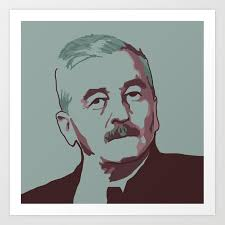
For 2022, I’ll be reading and re-reading several books by and about William Faulkner. When I was in college, I took a course on Southern Literature with Professor Margaret Whitt. That class, and that teacher, was one of the seminal experiences of my life (maybe I took 2 or 3 courses with her?), and it ignited a love of gothic lit and introduced me to so many authors—Sherwood Anderson, Katherine Anne Porter (everyone should read more KAP!), Carson McCullers (!!!), Flannery O’Connor, Ralph Ellison, etc., etc.—the combined influence of which I believe has had the most seismic and lasting effect on my own writing. 

For The Summer of Faulkner, I have five novels and one biography on my list. I realize this is probably unrealistic, but here we are. The good news is, I’ve already finished the biography, William Faulkner: The Man and the Artist. It’s excellent, written in a novelistic style, taking the reader from 1902, when “Billy” Faulkner’s family relocated to Oxford, Mississippi, to his death in a Byhalia sanatorium in 1962. Faulkner was, of course, famous for his writing but also for his prodigious drinking, and his life was struck by tragedy and a series of troubled, complicated romantic attachments and relationships. The emotional frustrations and drinking coexisted and interrelated, like linked, winding strands of his psychological DNA. He told an early paramour “Between grief and nothing I’ll always take grief,” and his biographer returns to this sentiment several times. Faulkner certainly weathered his share of grief, and physical ailments as well—he suffered a terrible burn after a drinking bout, and he had recurring back problems—more reason for him to turn to liquor.

I learned much about Faulkner, including his love of fox hunts (the “thrill of danger,” he said) and his time in Hollywood writing screenplays—primarily for the paychecks—and his travels back and forth. Later in life, he wrote about “the Negro problem” and his complicated sentiments about the South and Civil Rights that appear in these essays and, of course, throughout his entire oeuvre of fiction. Writers may want to reacquaint themselves with the wonderful speech he gave in 1950 when he won the Nobel Prize. You can read it here or listen to Faulkner himself here.

William Faulkner published 19 novels, 125 short stories (I didn’t mention the stories! So many stories, including “The Bear,” which some consider one of the best of all time), 20 screenplays, one play, six collections of poetry, and various essays. It seemed to me there were several approaches to choosing which novels to read but in the end, I went with a fairly simple strategy. I chose five novels in chronological order, during a particularly productive era of the writer’s life. Two of them I have read before, but it’s been many years. These five novels are:

The Sound and the Fury (1929)

As I Lay Dying (1930)

Sanctuary (1931)

Light in August (1932)

Absalom, Absalom! (1936)

There was a book in 1935 called Pylon, but I skipped that one. And to be honest, if anything doesn’t make the cut this summer, it’ll be the last one, Absalom, Absalom! I have read two of the more famous novels on the list, The Sound and the Fury and Light in August, and considered leaving the former off the list. But I didn’t, and I’ll be starting with The Sound and the Fury (if you recall, a title taken from Macbeth). Looking to confound and frustrate yourself over the calm, summer months? Join me! I’ll be reporting back on my progress as I take this adventure, and I’d love to hear your impressions as well.


Note: in 2005, Oprah did a Summer of Faulkner as part of her reading club, and you can buy three of these novels in a boxed set, if that's of interest. 

Wednesday, March 23, 2022

Film influences in Starling


Films and books have long held two neighboring places in my heart. As forms of storytelling, they have shaped and influenced me, each informing the other. I warn students of any class I teach that I will be referring, indiscriminately, to all forms of storytelling in our discussions—but what I mean by that is you will hear me talk about books, movies, television shows, Netflix series, songs, theater, etc.


Sometimes, writers are said to write in a “cinematic style” or with a “cinematic perspective,” and that has certainly been said about my writing from time to time. What is meant by this? It could mean the writing provides encompassing and vivid settings that are easy to visualize. Perhaps it means the form lends itself to the shape of film, with abrupt cuts from scene to scene or other techniques. Maybe it just means we can easily picture the book as a movie. For an excellent discussion of cinematic writing, look here.


I have a new novel, Starling, coming out in May. I started writing it a long time ago, and it has gone through many iterations. There are—what I suppose you can call—stylistic flourishes in it. I might as well be up front about this. In my experience, most people question or resist stylistic flourishes! Probably a result of our modern times, most of us feeling like we don’t have time for anything other than a direct line from A to B. But in Starling, aside from the main themes and story I wanted to explore, I also wanted it to say something about film, and about how these two forms of storytelling exist amicably for me, side by side.


Like me, the main character in the novel holds a lifetime of images in her mind. Gina has settled into a comfortable routine over the years, and feels her love of watching stories has expanded her horizons in many ways:


“Through television and movies, she had travelled all over. She knew Italy from Roman Holiday and Room with a View, California more from Chinatown and Irreconcilable Differences than her few visits to Deborah in Sacramento. She had digested entire chunks of history by watching television miniseries: twentieth century Australia in The Thorn Birds, the Civil War in North and South.”


Gina may have been influenced by her mother, a woman who named her oldest daughter after the actress Deborah Kerr and who sought refuge in a darkened living room after the kids had gone up to bed.


“Gina remembered a frequent sight: her mother, legs tucked underneath her on the tweed sofa, face lit by a flickering television screen. There was no getting her mother’s attention if she was watching something.”


And speaking of Deborah Kerr, there are certain images, certain scenes you will never be able to budge from your consciousness, once seen. Forward to 3:30 for the good part.

One of the inspirations for the novel was the idea of people creating their own realities. This has been a preoccupation of mine since college when I read Benedict Anderson’s Imagined Communities in a history class. A strange influence for fiction writing, I know, but the idea that nations could be/are formed by the collective imagining of their members—well, this has been something I’ve transferred to my fiction again and again, substituting "reality" for nations, and applying this idea to individual characters and families (even, especially, when “truth” is questionable). I never could have predicted how this basic premise would eventually affect my life, drastically and quite personally, but that’s another story altogether. In this novel, Gina has been living a life of her own making. And sometimes, the life we make can have illusionary aspects. We have so many films about alternate realities now and the ways technology has infiltrated our personal lives but when it came out in 1998, The Truman Show presented something novel—a person whose life ended up being something entirely unimagined. Gina catches glimpses of this movie on a long, international flight.


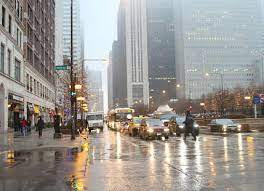
There are many visual references in the novel but in its first version, the opening scene was a protracted, stylistic flourish: a sequence of downtown Chicago during a storm. I wanted to describe and set the scene as a movie would. Here, the shot of commuters huddling underneath a bus stop shelter, there, cars inching down a drenched street. Then we follow the camera view to a single window in a high rise, where we focus on our hero, standing at the rain-streaked glass. This flourish has been shortened over the many drafts of the book, but the main intent is still there. The thing about images and stories and characters and silky dresses that bounce and glide around a palatial room—these things tend to attach themselves to other images and stories and the impossibility of a boat piercing through a piece of the horizon—and sometimes, something from our subconsciousness is unearthed unexpectedly. And this is what happens to Gina as she stands at that window. She’s been humming the tune from a Gap television commercial all day. It was a popular commercial at the time, in the 1990s, and I wish I could find a version with better quality.


“The song is simple, mesmerizing, and it’s been in her head all day. The visuals: dancers in t-shirts and khaki pants converge and split into various groupings…The dancers are young and happy, perfect skin in various hues. And somehow this song, these gliding forms, are tied to a memory of Gina’s father, talking about Elvis at a dinner party.” 

 And so it goes, memory tied to memory, images linked to others.


Wednesday, December 22, 2021

Favorite Reads, 2021


The year is drawing to a close and as I look back over my reading for the year, I realize I’ve fallen short of my goals. But it’s for good reasons. In 2021, I was fortunate to have an increased amount of editing work, which means I was reading future books rather than those already on the shelves. Also, I read a fair amount of student papers, and even started writing another novel. I’m grateful for all of these aspects of my reading and writing life! In the tradition of this blog, here are the stats for the year.

In 2021, I read 28 books—down from 44 in 2020 and 30 in 2019. This year’s leisure reading included 14 novels, 1 short story collection, 6 memoirs and 7 graphic novels. The graphic novels are, of course, novels, but I distinguish them as a separate category this year so I can give the format a little plug here. My typical procedure for my end-of-year list is to choose my five-star reads and this year, there were only six. In no particular order:


Echoland by Per Petterson (1989)

Per Petterson is one of my favorite authors, and I was surprised to find a novel of his on my shelf that I hadn’t read. The international, translated version of Echoland was released in 2016, but the novel was originally published in Norwegian in 1989. Petterson’s writing, for me, evokes a depth of feeling similar to the work of other favorites—Kent Haruf, Marilynne Robinson—a quality that is difficult to explain. He quietly presents everyday moments in their resplendent glory. Haruf called it “the precious ordinary.” These writers strike a chord for me, some universal understanding about life’s struggles and joys and questions. Echoland didn’t disappoint. A coming-of-age story, the novel follows Arvid, a 12-year-old on holiday in Denmark. Arvid has the energy and observational skills of young adulthood, and a fair amount of unbridled longing—for answers, for adventure, for autonomy. There’s a strain of grief in his family, and Arvid is awakening as a sexual being as well. And Petterson creates a mood of apprehension and expectation that brings the reader right along. It’s a remarkable novel.


The Haunting of Hill House by Shirley Jackson (1959) 

This National Book Award finalist by one of our great American masters is considered by some to be one of the best ghost stories—if not the best—written in the 20th century. Adaptations abound, such as the 2018 Netflix series. The novel involves the named house, and four main characters who have arrived to investigate the paranormal activities within. Reportedly, Jackson was inspired after reading about a group of 19th century “psychic researchers.” The resulting novel is about the house, but it’s really about the four characters and their pasts, motivations, and relationships. And it’s a spooky read, one that evokes a mood you won’t soon forget. I read this novel for my Summer of Houses project, and wrote more about it here.


Klara and the Sun by Kazuo Ishiguro (2021)

I had many thoughts when I finished this new novel by the acclaimed author of one of my favorite, all-time novels, The Remains of the Day, but the main one was simple: How did he do that? And by “that,” I mean, how did Ishiguro manage to write an entire novel from the point of view of an “Artificial Friend”—an unique and objective persona on the outskirts of human feeling and insight, and yet, manage to keep this reader enthralled and entirely engaged? The novel begins in a store, where Klara and the other AFs await purchase by a family. As she interacts with humans, Klara’s innocence and moldability act as a mirror in which humanity’s foibles and strengths materialize. The novel raises existential questions: what does it mean to be human, to love, to lose ourselves? What are the best parts of being human, and the worst? And it does all of this while presenting a plot with twists and turns. I’ll think about this book for a long, long time, and how it reflects and interacts with Ishiguro’s other books.


Pale Morning Light with Violet Swan by Deborah Reed (2020)

The more I think about that Petterson novel, the more I realize I probably left it on my To-Read stack on purpose, waiting for a calm period of time when I could fully enjoy and absorb it. The same is true for this novel by Deborah Reed, which I purchased as soon as it came out but waited for the right time to read. The author and I have been acquainted for some years; early on, we bonded over our mutual love of Haruf, Petterson, Robinson, and her writing, for me, lives in the same realm and always touches me on some visceral level. This novel presents Violet Swan, a ninety-three-year-old artist in the last chapter of her life. She lives quietly on the second floor above her only son and his wife, painting abstract, colorful versions of comfort and calm. But a storm is brewing inside Violet, and the arrival of her beloved grandson sets in motion a string of events and the unearthing of memories she has kept hidden most of her life. It’s a stirring novel, full of soul and purpose and what Ms. Reed’s writing always means to me—that nurturing of an innate recognition of the feelings and complexity of our lives. This story and these characters are expertly drawn and continue to walk around in some corner of my mind.


Almost American Girl by Robin Ha (2020)

Almost American Girl is a memoir that begins with the teen Robin, whose life in Seoul, Korea, is disrupted when her mother announces a move to America. She leaves her friends and life behind, abruptly dropped into a place where she doesn’t speak the language or know the customs. Her relationship with her mother ruptures and she’s cut off from the world of comics she enjoyed in Korea. Robin’s story echoes the struggles many immigrants face, and it makes insightful observations about identity, gender expectations, and the power of artistic expression. Ha wrote and illustrated the book in muted colors that reflect her experiences, both in Korea and her new home, and the confusion of arriving in a foreign place and trying to make connections. If you haven’t dipped your toe into graphic/illustrated books yet, this would be a great place to start.


Long Way Down: The Graphic Novel by Jason Reynolds (2020)

Will is a teenager who’s just lost his older brother, Shawn, to what appears to be a gang shooting. Boys and young men in Will's neighborhood are taught three rules: No crying, no snitching, and always get revenge. So Will grabs a gun and sets out to avenge his brother’s death. Long Way Down takes place during the elevator ride in Will’s building; at each floor, he’s visited by the ghosts of men lost to gun violence. As they tell their stories and advise Will, he goes through a rollercoaster of emotions as he decides whether to live by the rules or not. This graphic novel version is an adaptation of Reynold’s 2017 award-winning book of the same name, and it’s truly enhanced by Danica Novgorodoff’s illustrations. She presents watercolor images that bleed through panes and create an eerie, memorable effect. Another highly recommended entry to the world of graphic novels, if you’re interested.


And speaking of graphic novels, here are some more recommendations. I read mostly in the YA and Middle Grade categories, because of the Children’s Literature class I teach, but I’m looking to expand more into adult offerings in the new year.


The Magic Fish by Trung Le Nguyen (2020)

Tien communicates with his Vietnamese immigrant mother through the fairy tales they read together. She struggles with English, and he struggles with coming out. This beautifully illustrated novel is touching and lyrical, a true reading experience.


Daytripper by Fabio Moon (2011)

This unique book presents several versions of the life of Bras de Olivias Deominguez, and several versions of his death. Each chapter starts at a different point of his life, demonstrating life’s possibilities, joys and sorrows, and in the end, the tenuousness of existence itself. Uniquely, brilliantly illustrated.


American Born Chinese by Gene Luen Yang (2008)

A ground-breaking, acclaimed book that reads like a modern fable. Three distinct characters come together in unexpected ways in this novel that touches on Chinese history, immigration, and self-realization.


"As soon as we express something, we devalue it strangely. We believe ourselves to have dived down into the depths of the abyss, and when we once again reach the surface, the drops of water on our pale fingertips no longer resemble the ocean from which they came...Nevertheless, the treasure shimmers in the darkness unchanged." ---Franz Kafka