Sunday, July 29, 2012

Storage Wars

Have you ever seen that show Storage Wars? It airs on A&E and is described on their website as an “original real-life series…which follows four professional buyers and their teams as they scour repossessed storage units in search of hidden treasure.”

The episodes begin at a storage facility in southern California. The entire operation is run by an auctioneer and some sort of overseer. Many people show up to bid on the units, but everyone is allowed just a quick glance inside before each auction begins.

Prior to seeing the show, I suppose I hadn’t considered what happens to items in storage units that go unclaimed. Units are repossessed when owners disappear, but they’re also repossessed when someone can’t pay their storage bill for a period of time. Or, I suppose, when the owner dies and no one comes to claim the stuff. An aside: I get preoccupied with this aspect of the show, the wondering about what happened to these people? Sometimes, the unit seems to hold someone's every possession and yet…where did they go? A&E should have another show tracing these disappearances, in my opinion.

After the auction, the “professional buyers” (two own resale/consignment shops) enter the units they purchase and start to dig. Sometimes they find interesting, potentially valuable items and sometimes they don’t. At the end of the day, profits and losses are tallied.

The appeal of the show stems from two aspects: the personalities of the buyers and the chance that we could watch them find a million dollars, basically. This last thing far outweighs the personality part, which is mostly editorially enhanced, I think. But once in a while there’s a true surprise and that’s exciting, the thought that each of us could have, among our belongings, something immensely valuable.

I bring this up because like most things, it reminds me of the creative process. Our brain is a storage unit full of thoughts and memories and we are the professional buyers, pulling up the big metal door to excavate for possible riches. At times, there’s something obvious. If one of the buyers of Storage Wars is lucky enough to buy a unit that contains a safe, and if, when they crack open the safe and find a load of gold coins…well, you can be pretty certain it'll be worth some money. But if they find a strange, engraved box which plays music when you open it and seems to have some German writing on the bottom…you won’t know until the end of the show whether this might make the buyer’s day/week/year.

I think all writers begin with the big ticket items. Traumatic events from childhood, people, places and ideas that stimulated and educated us as we grew up, conflicts with parents, our first romantic relationships, our first travels, even styles of writing we found exciting. These, all important, all worthy of appraisal. Later, when you have to dig a little deeper—the time your family was on vacation and a girl was missing, a stunted flirtation you sometimes think about, the reason you quit that job/relationship/belief system. (By the way, none of these are personal; I made them up). Oh, and you can also completely make things up.

Luckily, our lives are continually forming new storage units; items continue to pile up and you never know for sure which ones will bring what you’re looking for. One difference, I suppose: there are no other “buyers’ for your unit. You have to fight with yourself.

Tuesday, July 17, 2012

What a Good Book Does


Jess Walter’s new novel, Beautiful Ruins, begins on the banks of a sleepy Italian town once named for its proliferation of prostitutes, while a young man recently returned home moves sand around, trying to make a beach to attract American tourists to his family’s hotel.

This man, Pasquale, has illusions of grandeur, which endears and endangers him equally, and each character in Walter’s book seems to have their own vision of reality which may or may not align with actual life. As though each of us constructs realities which become admirable and yet, impossible. Beautiful ruins. But in this novel, the title works on many levels.

The story moves back and forth in time, from Hollywood of the 1960s and the isolated Italian village where news of movie stars seeps in, to current day, when modern notions of celebrity and success can dilute even the purest of artistic sensibilities.

Walter’s style is vivid and Technicolor, each scene painted with practiced hands. There are moments of wisdom, moments of great feeling. A good book makes you stop and close your eyes, savoring description. A good book will cause you to marvel at its construction, at each diligently crafted piece and the way they fit together. A good book will make you say “I wish I wrote that” many, many times. And a good book will keep you awake after you finish, thinking about the many threads of its tapestry, synapses in your brain firing and refiring. A good book makes you feel like you may not write anything for a while. I loved Beautiful Ruins. You can buy it here. And tonight, I’m going to hear Jess Walters talk about it here. A few tickets still available, I believe.

Saturday, July 7, 2012

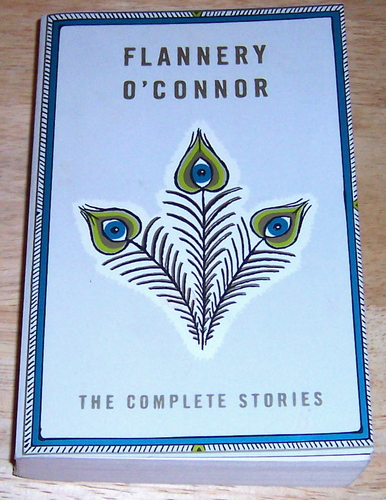
Flannery O'Connor

Mary Flannery O’Connor lived from 1925 to 1964, a short life with its share of hardship and tragedy. When she was fifteen, her father died from systemic lupus erythematosus, the same disease which would be the cause of her death at 39 years of age. O’Connor was a fervent Catholic who struggled with religion and belief, and her fiction is largely defined by tragedy, loss and human struggle, and her spiritual contemplations.

I spent many years in Catholic school so I can relate to how a religious upbringing adds color, magic and drama to a childhood. In O’Connor’s fiction, God is a tangible force and biblical stories blend with stories of family until they hold the same weight. It was a blessing and a curse, the way that O’Connor believed, and this curse affected her characters, whether they were believers or not.

The Violent Bear it Away is the story of Tarwater, a would-be prophet kidnapped by his great uncle as a baby. Raised on a steady diet of prophesy, Tarwater finally breaks free and pursues his cousin, Rayber, a schoolteacher who had escaped the uncle to live a godless life. The conflict between religion and secularism (the paths chosen by the uncle and Rayber) are at the heart of the novel, meeting in the character of Tarwater, who now has to choose his future.

This all makes it sound like a dry read, which it is certainly not. O’Connor’s characters are crude and vivid and often, darkly humorous. She seems to bypass the veins of existence and get to the very arteries of human existence—the fear, the compassion, the primal urges. Even when the characters are displaying their worst selves, we can relate to their feelings. The story clips along, suspenseful and eerie. At times, it reads like a mystery or thriller. And throughout the novel, the atmosphere of the South seeps in…the dense, fragrant air, the buzzing of insects. Irony and tragedy and the struggles that define life. If you haven’t read either of O’Connor’s novels--this one, or Wise Blood, or any of her masterful short stories, I highly recommend. More on her life here, and an introductory study of her life and work here, written by the professor who introduced me to O’Connor’s writing.

Saturday, June 30, 2012

Stepping into a Story


For those of you following our adventures via social media, you know that my son Teagan and I just returned from a mini-vacation to Austin. We stayed in and around the city and got a pretty good overview of the place. Texas has a flavor all its own. Everywhere you look, there are symbols of the state: the longhorns, symbolizing the ranching history but also the local college team, the flag, displayed at every street corner six inches below the US flag (a bragged concession) and wherever they can manage it, a five-pointed star, the symbol of this Lone Star State. And all of it implies shared identity, and this identity stems from story. The story of the great state of Texas: the settling of the vast land, its brief period as a sovereign nation, the Alamo, the annexation into the United States (recast as Texas’s triumph), the state’s continuing riches. You can’t go anywhere without being reminded, almost constantly, of this story. Symbols are everywhere to guide you back. The surroundings are steeped in the past and I’m not sure I’ve ever been anyplace where this was so obviously the case.

And it reminded me of novels. This is what we hope for as writers, that our readers will feel as though they have stepped right into a story, become immersed in it. We have only to set up the symbols to jog memory, to light the path with reminders. Metaphor, theme, trope: these are our signposts. Wherever you go within the novel, it all leads back to the same place, the central story, and it’s the shared imagination that gives it lasting power.

Tuesday, June 19, 2012

On Reviewing, Part Deux


Have you ever owned a box fan? You know the type—looks like a big box with a fan housed inside. You can prop it inside a window frame to drag in fresh, cooler air or you can sit directly in front of one and hear your voice vibrate.

Seems like a pretty simple contraption. Plug goes into the wall and starts a motor, which gets the fan blades rotating. The blades push air quickly forward.

What if you own a box fan and notice that the fan blades are covered with dirt and what if, one afternoon, you decide to take apart the fan (how hard could it be?), clean the grime off, and put the thing back together? All you need is a screwdriver and the sense that you’re the type of person who gets things done, a handy, problem-solver who likes clean belongings.

The first part is easy. You unplug the fan and lay it on its side. Two screws hold the front plastic screen in place. Once that’s off, you realize you could probably clean the blades now (easily, quickly!) but you decide to remove them for a proper soaking in the sink. The dirt is greasy and really stuck on. As it turns out, the blades are actually one big piece and there are a few more screws and some round thing involved with getting it off, and then it doesn’t exactly fit in the sink so you spray it with hot water over the sink and use dishwashing soap to loosen the grime.

It goes back together easily enough, but when you’re finished, you’ve forgotten the round thing and so you have to unscrew everything again and after the second time, the fan blades seem to sit crookedly and in their current position will probably scrape into the plastic screen. Your back is hurting now from leaning over. The plastic screen is also dirty, you notice, each tiny rectangle with a tiny strip of dust. Back to the sink and the sprayer. Also, you notice there’s a screw left over, a larger, gray-tipped one you don’t remember taking off.

For me, reviewing books is like taking the fan apart and writing books is like putting one together. With both you understand, in general, how the machine works and you are able to identify the parts. But when you assemble a fan (or a bookshelf, or a radio, or a child’s electronic toy, or a book, etc.), unforeseen complications arise. Things do not go according to plan. You may have to go back to the beginning or read the directions more carefully. Sometimes you have to take a break to avoid frustration. There are missing parts and occasionally, parts you don’t need. It is always, always more complicated than you think it will be. Sometimes you may wonder why you started at all. And even after the blades are cleaned and lined up and every piece has been discarded or accounted for, even then you're not sure whether the thing will run when you plug it in. You may have to take it apart again. And again.
"As soon as we express something, we devalue it strangely. We believe ourselves to have dived down into the depths of the abyss, and when we once again reach the surface, the drops of water on our pale fingertips no longer resemble the ocean from which they came...Nevertheless, the treasure shimmers in the darkness unchanged." ---Franz Kafka